F
Field Ethos
Guest
By Logan Metesh
Of the 56 men who signed the Declaration of Independence, 48 of them were born on the American continent. The remaining eight hailed from across the pond, but only one of them died defending his honor in a duel.
Button Gwinnett, who’s odd first name was in honor of his godmother Barbara Button, was born in Down Hatherley, England, in 1735. (Fun fact: Famous African hunter Frederick Courteney Selous lived there for a time.) In 1762, he and his wife packed up and headed for the Americas, arriving first in Newfoundland before heading to Jamaica in search of work. His ventures in Newfoundland and Jamaica didn’t fare well, and his store in Savannah, Georgia, suffered the same fate.
As a result, he did what all shit businessmen do: he took out a huge line of credit and bought a 22,000-acre private island to become a gentleman planter. In this case, St. Catherines Island south of Savannah. To no one’s surprise, the venture failed and by 1773, his creditors had taken it all back.
As plenty of failed private sector businessmen have done in the centuries that followed, Button sought refuge in politics and was finally able to make some money at the expense of Georgia’s taxpayers. His position in the Provincial Assembly led him to cross paths with Lachlan McIntosh, a Scotsman who became his biggest rival and, eventually, his killer.
His role in the Assembly earned him a vote to represent Georgia in the Continental Congress where he voted for independence on July 2, 1776. He was one of many Signers who didn’t actually sign the document until the now-famous copy was ready in August.
During his time in Congress, his rivalry with McIntosh intensified when he was passed over for the brigadier general position with the 1st Regiment in the Continental Army. As a consolation prize, he became the eighth governor of Georgia instead. In that capacity, he sought to screw with McIntosh at any opportunity.
First, he had Lachlan McIntosh’s brother George arrested and charged with treason against the revolutionary cause. His treasonous act was helping a merchant to buy rice for the British troops in Florida.
In his capacity as governor, Gwinnett technically outranked McIntosh when it came to Georgia’s fighting men, and so the brigadier general had no choice but to obey Button’s orders to invade British-controlled East Florida in April 1777. The attack was an abject failure; Gwinnett and McIntosh blamed each other for the dismal performance.
On May 1, 1777, Brigadier General Lachlan McIntosh rose to speak in front of the Georgia assembly in support of Governor Button Gwinnett’s opponent for the governor’s seat, John Treutlen. In his speech, Lachlan called Button a “scoundrel and lying rascal.”
I’m sure bar fights have ensued for far less, but when Lachlan refused to apologize, Button had no choice but to challenge him to a duel in an attempt to regain his honor.
The brigadier general and the governor met on land owned by James Wright, who had been the sixth governor of Georgia, on Friday, May 16, 1777, to participate in the obligatory duel.
Each man marched out to 12 paces with an engraved, brass-mounted flintlock pistol in one hand. They turned and fired almost simultaneously. McIntosh was wounded in the leg while Gwinnett was wounded just above the knee. As it turned out, McIntosh’s wound wasn’t so bad; he soon recovered. Gwinnett, on the other hand, suffered through the weekend and succumbed to infection on Monday, May 19, 1777.
Support for Button Gwinnett was so great that Lachlan McIntosh was actually arrested and tried for murder. When he was acquitted, none other than General George Washington himself ordered McIntosh to his headquarters. He was with Washington and the tired Continental Army as they endured the brutal winter at Valley Forge, Pennsylvania.
The flintlock pistols used by the men that day survive. They are now a part of the museum collection at the Georgia Historical Society in Savannah.
McIntosh lived to be 80, dying in 1806. He is buried in a marked grave in Colonial Park Cemetery in Savannah. Gwinnett, on the other hand, was lost track of not long after his death in 1777. To this day, no one knows for sure where the governor and Signer of the Declaration of Independence is buried.
…
Editor’s Note: Gwinnett’s limited notoriety prior to singing the Declaration of Independence, combined with his quick death, thereafter, make his signature one of the most sought after autographs in the weird market to attain all of the 56 original Signers. Reportedly, only 51 examples of Gwinnett’s signature are known to exist, with only 10 in private hands. A signed letter in 2010 brought a whopping $722,500, which completed a full set for a collector.
The post The Dead, Dueling Declaration Signer appeared first on Field Ethos.
Continue reading...
Of the 56 men who signed the Declaration of Independence, 48 of them were born on the American continent. The remaining eight hailed from across the pond, but only one of them died defending his honor in a duel.
Button Gwinnett, who’s odd first name was in honor of his godmother Barbara Button, was born in Down Hatherley, England, in 1735. (Fun fact: Famous African hunter Frederick Courteney Selous lived there for a time.) In 1762, he and his wife packed up and headed for the Americas, arriving first in Newfoundland before heading to Jamaica in search of work. His ventures in Newfoundland and Jamaica didn’t fare well, and his store in Savannah, Georgia, suffered the same fate.
As a result, he did what all shit businessmen do: he took out a huge line of credit and bought a 22,000-acre private island to become a gentleman planter. In this case, St. Catherines Island south of Savannah. To no one’s surprise, the venture failed and by 1773, his creditors had taken it all back.
As plenty of failed private sector businessmen have done in the centuries that followed, Button sought refuge in politics and was finally able to make some money at the expense of Georgia’s taxpayers. His position in the Provincial Assembly led him to cross paths with Lachlan McIntosh, a Scotsman who became his biggest rival and, eventually, his killer.
The Signer
His role in the Assembly earned him a vote to represent Georgia in the Continental Congress where he voted for independence on July 2, 1776. He was one of many Signers who didn’t actually sign the document until the now-famous copy was ready in August.
During his time in Congress, his rivalry with McIntosh intensified when he was passed over for the brigadier general position with the 1st Regiment in the Continental Army. As a consolation prize, he became the eighth governor of Georgia instead. In that capacity, he sought to screw with McIntosh at any opportunity.
First, he had Lachlan McIntosh’s brother George arrested and charged with treason against the revolutionary cause. His treasonous act was helping a merchant to buy rice for the British troops in Florida.
-
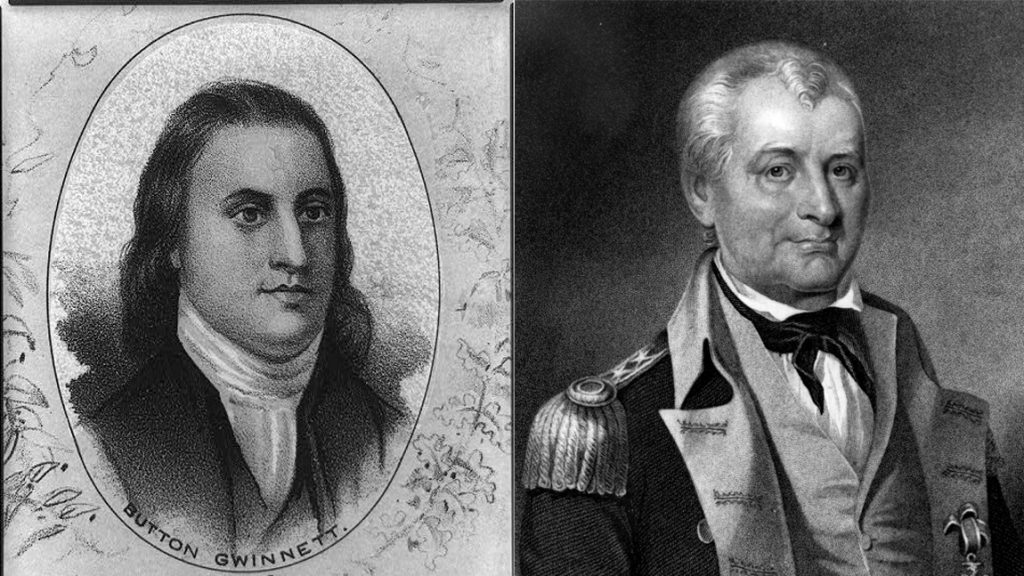
Button Gwinnett (left) and his rival Lachlan McIntosh. 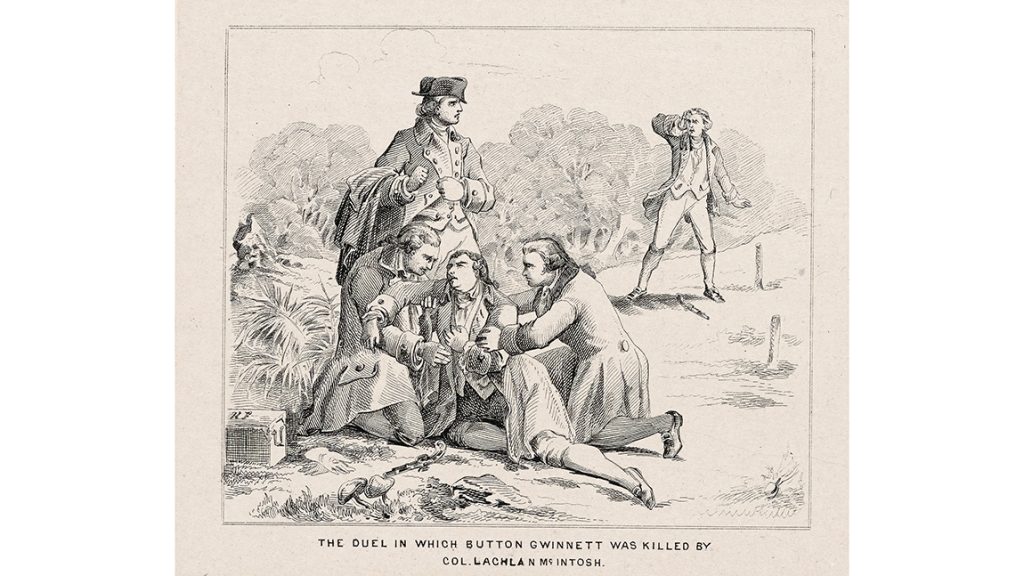
In his capacity as governor, Gwinnett technically outranked McIntosh when it came to Georgia’s fighting men, and so the brigadier general had no choice but to obey Button’s orders to invade British-controlled East Florida in April 1777. The attack was an abject failure; Gwinnett and McIntosh blamed each other for the dismal performance.
On May 1, 1777, Brigadier General Lachlan McIntosh rose to speak in front of the Georgia assembly in support of Governor Button Gwinnett’s opponent for the governor’s seat, John Treutlen. In his speech, Lachlan called Button a “scoundrel and lying rascal.”
I’m sure bar fights have ensued for far less, but when Lachlan refused to apologize, Button had no choice but to challenge him to a duel in an attempt to regain his honor.
The Duel
The brigadier general and the governor met on land owned by James Wright, who had been the sixth governor of Georgia, on Friday, May 16, 1777, to participate in the obligatory duel.
Each man marched out to 12 paces with an engraved, brass-mounted flintlock pistol in one hand. They turned and fired almost simultaneously. McIntosh was wounded in the leg while Gwinnett was wounded just above the knee. As it turned out, McIntosh’s wound wasn’t so bad; he soon recovered. Gwinnett, on the other hand, suffered through the weekend and succumbed to infection on Monday, May 19, 1777.
Support for Button Gwinnett was so great that Lachlan McIntosh was actually arrested and tried for murder. When he was acquitted, none other than General George Washington himself ordered McIntosh to his headquarters. He was with Washington and the tired Continental Army as they endured the brutal winter at Valley Forge, Pennsylvania.
The flintlock pistols used by the men that day survive. They are now a part of the museum collection at the Georgia Historical Society in Savannah.
McIntosh lived to be 80, dying in 1806. He is buried in a marked grave in Colonial Park Cemetery in Savannah. Gwinnett, on the other hand, was lost track of not long after his death in 1777. To this day, no one knows for sure where the governor and Signer of the Declaration of Independence is buried.
…
Editor’s Note: Gwinnett’s limited notoriety prior to singing the Declaration of Independence, combined with his quick death, thereafter, make his signature one of the most sought after autographs in the weird market to attain all of the 56 original Signers. Reportedly, only 51 examples of Gwinnett’s signature are known to exist, with only 10 in private hands. A signed letter in 2010 brought a whopping $722,500, which completed a full set for a collector.
The post The Dead, Dueling Declaration Signer appeared first on Field Ethos.
Continue reading...
