F
Field Ethos
Guest
By Edgar Castillo
On April 12, 1961, the Vostok 1 rocket launched from the Soviet Union and broke through the Earth’s atmosphere and into an infinite unknown. The capsule’s lone occupant, Yuri Gagarin, became the first human to journey into outer space, orbiting the planet once during its 108-minute flight, and marking the start of space exploration. His monumental achievement was a major victory for Mother Russia, captivating the world, and more importantly leaving their Cold War adversary, the United States, with a mix of shock, fear, and embarrassment.
But, before Yuri obtained national hero status, the Russki born spaceman fought advancing German’s during WWII as a 7-year-old boy. Like millions of Soviet citizens, Yuri’s family suffered during the partial Nazi occupation of the country. Their farmstead, land, and livestock were seized by occupying German soldiers in October of 1941 during their advance towards Moscow. The overran town was up for the taking and an “offizier” assumed residence in Yuri’s home, forcing the family to build a tiny, windowless mud hut nearby, measuring 9 feet by 9 feet. There they spent 21 months until the occupation ended.
Though the family had been spared, Yuri’s disdain for the German’s swelled. Forced to labor their own farm to feed the soldiers, rations became scarce and almost non-existent at times. Being a resourceful youngster, there were vague accounts of Yuri sneaking out to the nearby woods to gather edibles and hunt for hazel and black grouse and other game. Sustaining his family wasn’t enough. More had to be done.
One day, a German soldier attempted to hang his younger brother by his own scarf from an apple tree. This cruel act pushed Yuri over the edge. His fear for his family turned to pure hatred for the Germans, thrusting him into becoming a saboteur. In retaliation, Yuri began pouring soil into tank batteries gathered to be recharged, randomly mixing different chemical supplies, as well as other acts of guerilla warfare made to disrupt the Nazi scum operations. These tactics and his uncontrollable antics earned Yuri the nickname “The Devil Child” by the Germans.
After the war, Yuri moved to a village, later renamed Gagarin, after him, 20 miles away. In school he excelled in mathematics and physics. After graduating with honors at the age of 17, Yuri began training as a Soviet air cadet and learned how to fly. In 1955, he was accepted into pilot school, flying MiG-15s, and within two years was commissioned as a lieutenant. As a gifted fighter pilot, Yuri was one of 20 selected to be a cosmonaut in 1959 as part of a program to launch a man into space.
In between the rigorous training, Yuri found relaxation in the Russian countryside. He found refuge in the forests, marshes, and steppe edges, where the only countdown was the flush of a grouse and the roar from his shotgun that tracked the whir of wingbeats from ducks and pheasants. Wingshooting was a regular activity and a favorite pastime among Yuri and his fellow trainees.
By the time selection came around, Yuri was unanimously voted as the best candidate and within two years the Russian cosmonaut found himself circling the Earth and in the spotlight. To escape the flashing cameras and the Kremlin’s overbearing oversight, Yuri turned to his passion for bird hunting to gain pause in his life. Yuri was not alone when he went. Because he was involved in the space program, the KGB followed. Lucky for him, most of the secret police assigned to him joined him in his bird hunts.
Yuri was known to be thorough in everything he did. He approached every bird hunting outing like a space mission: scouting locations days prior, monitoring migration patterns of waterfowl, checking tides for shore bird activity, and meticulously cleaning his shotgun before an outing.
He preferred wingshooting over other hunting pursuits. Yuri would hunt several types of grouse, ducks, snipe, and woodcock in nearby floodplains and woodlands. His bird hunting style was classic Russian – walk-and-flush, often using pointers and flushing dogs. These birds demanded stealth, timing, and intimate knowledge of terrain, habitat, and wind. Attributes he formed from his disciplined military training and experience.
Yuri’s primary choice of shotgun was a Soviet made side-by-side double-barrel TOZ-34 20-guage—a regular workhorse in the field. Its reliability overshadowed its subtle elegance with its walnut stock and hand-fitted barrels. When Yuri needed a bit of oomph for killing larger birds at longer distances, he turned to a single-barrel IZh-54 12-gauge.
The cosmonaut wielded both shotguns well and was known to be a precision shot. He avoided semi-autos—preferring the simplicity of break-open-actions, and the pause between shots. It forced Yuri to be disciplined and not to rush shots. His mission was to kill, not wound birds. “One shot, one bird— if you miss, you earn the walk,” Yuri reportedly said. He valued close-range shots, rarely taking birds beyond 35 yards. A friend recalled: “Yuri never rushed the trigger. He’d wait, sometimes seconds, until the gamebird was steady, wings fully open. That same patience was shown in the Vostok’s cabin, waiting for retrofire.”
Tragedy struck on March 27, 1968, when Yuri perished during a training flight. Just weeks prior he had gone on his last hunting trip. He had gone into the woods and brought back a brace of woodcock for dinner, where he joked about a “missed double” on snipe. He was planning a spring stalk for blackcock grouse. Bird hunting was more than a pastime for Yuri, it was a rhythm, ritual, and release of the stressors from being a Russian cosmonaut. His joy came from the excitement of flushed birds, and the feel of feathers in his hands—it was about connection—to the land, to fellow comrades, and the stillness of life that he observed from hundreds of miles from the heavens as he hurled around the stars.
The post The Saboteur, Cosmonaut Bird Hunter appeared first on Field Ethos.
Continue reading...
On April 12, 1961, the Vostok 1 rocket launched from the Soviet Union and broke through the Earth’s atmosphere and into an infinite unknown. The capsule’s lone occupant, Yuri Gagarin, became the first human to journey into outer space, orbiting the planet once during its 108-minute flight, and marking the start of space exploration. His monumental achievement was a major victory for Mother Russia, captivating the world, and more importantly leaving their Cold War adversary, the United States, with a mix of shock, fear, and embarrassment.
But, before Yuri obtained national hero status, the Russki born spaceman fought advancing German’s during WWII as a 7-year-old boy. Like millions of Soviet citizens, Yuri’s family suffered during the partial Nazi occupation of the country. Their farmstead, land, and livestock were seized by occupying German soldiers in October of 1941 during their advance towards Moscow. The overran town was up for the taking and an “offizier” assumed residence in Yuri’s home, forcing the family to build a tiny, windowless mud hut nearby, measuring 9 feet by 9 feet. There they spent 21 months until the occupation ended.
Rise of the Saboteur
Though the family had been spared, Yuri’s disdain for the German’s swelled. Forced to labor their own farm to feed the soldiers, rations became scarce and almost non-existent at times. Being a resourceful youngster, there were vague accounts of Yuri sneaking out to the nearby woods to gather edibles and hunt for hazel and black grouse and other game. Sustaining his family wasn’t enough. More had to be done.
One day, a German soldier attempted to hang his younger brother by his own scarf from an apple tree. This cruel act pushed Yuri over the edge. His fear for his family turned to pure hatred for the Germans, thrusting him into becoming a saboteur. In retaliation, Yuri began pouring soil into tank batteries gathered to be recharged, randomly mixing different chemical supplies, as well as other acts of guerilla warfare made to disrupt the Nazi scum operations. These tactics and his uncontrollable antics earned Yuri the nickname “The Devil Child” by the Germans.
-
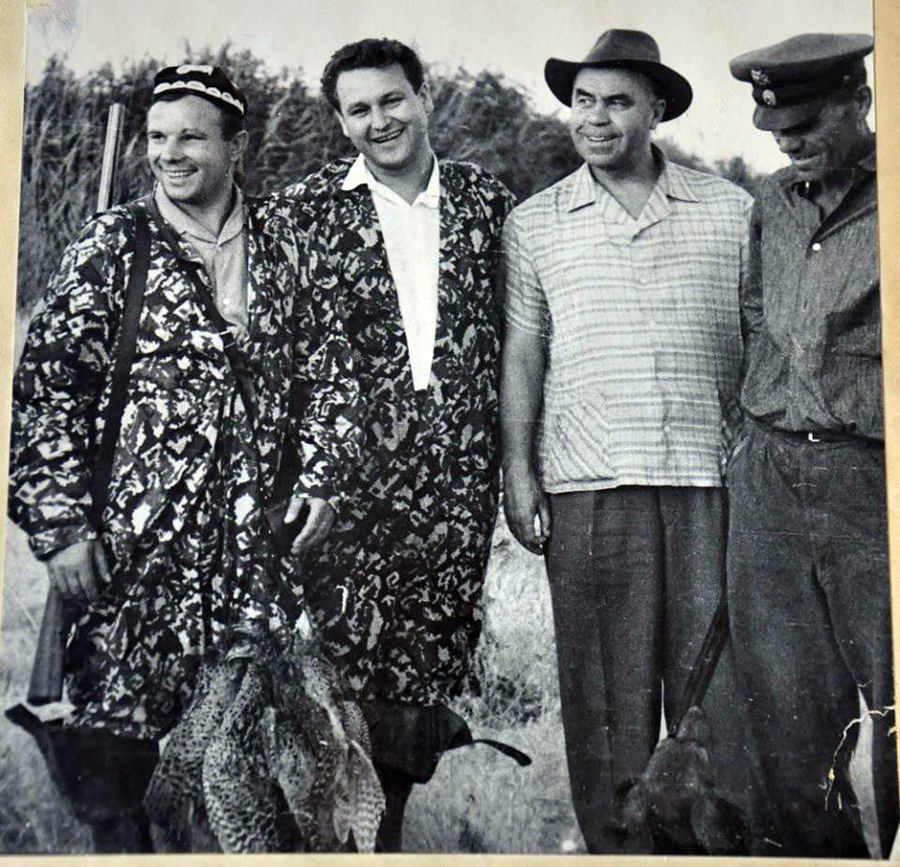
Yuri Gagarin (far left) had a passion for bird hunting. 
Flight of the Cosmonaut
After the war, Yuri moved to a village, later renamed Gagarin, after him, 20 miles away. In school he excelled in mathematics and physics. After graduating with honors at the age of 17, Yuri began training as a Soviet air cadet and learned how to fly. In 1955, he was accepted into pilot school, flying MiG-15s, and within two years was commissioned as a lieutenant. As a gifted fighter pilot, Yuri was one of 20 selected to be a cosmonaut in 1959 as part of a program to launch a man into space.
In between the rigorous training, Yuri found relaxation in the Russian countryside. He found refuge in the forests, marshes, and steppe edges, where the only countdown was the flush of a grouse and the roar from his shotgun that tracked the whir of wingbeats from ducks and pheasants. Wingshooting was a regular activity and a favorite pastime among Yuri and his fellow trainees.
By the time selection came around, Yuri was unanimously voted as the best candidate and within two years the Russian cosmonaut found himself circling the Earth and in the spotlight. To escape the flashing cameras and the Kremlin’s overbearing oversight, Yuri turned to his passion for bird hunting to gain pause in his life. Yuri was not alone when he went. Because he was involved in the space program, the KGB followed. Lucky for him, most of the secret police assigned to him joined him in his bird hunts.
Yuri was known to be thorough in everything he did. He approached every bird hunting outing like a space mission: scouting locations days prior, monitoring migration patterns of waterfowl, checking tides for shore bird activity, and meticulously cleaning his shotgun before an outing.
Adventures of the Bird Hunter
He preferred wingshooting over other hunting pursuits. Yuri would hunt several types of grouse, ducks, snipe, and woodcock in nearby floodplains and woodlands. His bird hunting style was classic Russian – walk-and-flush, often using pointers and flushing dogs. These birds demanded stealth, timing, and intimate knowledge of terrain, habitat, and wind. Attributes he formed from his disciplined military training and experience.
Yuri’s primary choice of shotgun was a Soviet made side-by-side double-barrel TOZ-34 20-guage—a regular workhorse in the field. Its reliability overshadowed its subtle elegance with its walnut stock and hand-fitted barrels. When Yuri needed a bit of oomph for killing larger birds at longer distances, he turned to a single-barrel IZh-54 12-gauge.
The cosmonaut wielded both shotguns well and was known to be a precision shot. He avoided semi-autos—preferring the simplicity of break-open-actions, and the pause between shots. It forced Yuri to be disciplined and not to rush shots. His mission was to kill, not wound birds. “One shot, one bird— if you miss, you earn the walk,” Yuri reportedly said. He valued close-range shots, rarely taking birds beyond 35 yards. A friend recalled: “Yuri never rushed the trigger. He’d wait, sometimes seconds, until the gamebird was steady, wings fully open. That same patience was shown in the Vostok’s cabin, waiting for retrofire.”
Tragedy struck on March 27, 1968, when Yuri perished during a training flight. Just weeks prior he had gone on his last hunting trip. He had gone into the woods and brought back a brace of woodcock for dinner, where he joked about a “missed double” on snipe. He was planning a spring stalk for blackcock grouse. Bird hunting was more than a pastime for Yuri, it was a rhythm, ritual, and release of the stressors from being a Russian cosmonaut. His joy came from the excitement of flushed birds, and the feel of feathers in his hands—it was about connection—to the land, to fellow comrades, and the stillness of life that he observed from hundreds of miles from the heavens as he hurled around the stars.
The post The Saboteur, Cosmonaut Bird Hunter appeared first on Field Ethos.
Continue reading...
