F
Field Ethos
Guest
By Will Dabbs, MD
Nuclear energy is fairly horrifying if you think about it. The physical laws of conservation of matter and energy posit that matter and energy can be neither created nor destroyed. They can only change forms.
When you burn a match, the match doesn’t just go away. The wooden fuel transforms into soot, ash, and hot gas. Likewise, the chemical energy intrinsic in the match stick is converted into heat and radiant energy. With the appropriate instruments, you can measure all of that. It will always sum to zero. However, that doesn’t apply to nuclear reactions.
In the case of nuclear fission, a small amount of matter actually transforms into energy in accordance with Einstein’s E=MC2. Once the dust settles, that matter no longer exists in the universe. We’re really not completely sure where it goes, but we’re sure it’s no longer here.
As regards E=MC2, a little bit goes a really long way. In SI units, Energy is joules, Mass is kilograms, and C is the speed of light—299,792,458 meters per second. That’s pretty bizarre, but it gets even weirder taken in context.
On August 6, 1945, we dropped the world’s first operational nuclear weapon onto Hiroshima, Japan. That bomb was fueled by 141 pounds of uranium-235. It detonated 1,968 feet above the ground and released the equivalent energy of 30 million pounds of conventional Trinitrotoluene high explosive.
Of those 141 pounds of enriched uranium-235, two pounds underwent nuclear fission. Of those two pounds, less than a gram of that uranium was actually transformed into energy in accordance with Einstein’s equation. That’s about the same mass as a small paperclip. It’s less than a dollar bill. That much uranium killed 146,000 people. As I said, nuclear anything is just discomfiting. However, getting there was even scarier.
Enrico Fermi was born in 1901 in Rome, Italy. His father worked for the railroad. His mom taught school. As young Enrico ploughed his way through university, he found that he had a knack for physics.
Fermi earned the Nobel Prize in 1938 at age 37. After traveling to Stockholm to receive his accolades, he and his Jewish wife Laura proceeded to America to escape the suffocating racial laws that characterized fascist Italy. Once in the U.S., Fermi eventually settled at the University of Chicago. There he busied himself piddling with uranium.
In late 1942, Fermi and his peeps stacked some 45,000 ultra-pure graphite bricks around 50 short tons of sort-of refined uranium arranged on the squash court underneath the bleachers at the University of Chicago football stadium. They used cadmium rods to absorb excess neutrons and keep the diabolical stuff well-behaved. Fermi himself described his contraption as, “A crude pile of black bricks and wooden timbers.” They christened the device CP-1, short for Chicago Pile-1.
This was a dark road…a brave new world…an undiscovered country. Prior to this moment, the planet had never seen self-sustaining nuclear fission. In theory, raising and lowering the control rods should meter the energy output, but that was just hypothetical. This had never been attempted before.
A scientist named Samuel Allison hovered on a scaffold high above the apparatus with a big bucket of cadmium nitrate. It was hoped that, should things go truly pear-shaped, this stuff would tamp down the reaction long enough for everybody to run. However, there was no way to be sure.
Fermi and his buddies had exhaustively modeled this thing. As they calculated the sundry possible outcomes, they determined that there was a 15% probability that the reaction, once initiated, would propagate exponentially, consuming the football stadium, the city of Chicago, the state of Illinois, North America, and, eventually, the entirety of Planet Earth. Were this the case, this unprecedented reaction would have transformed our lovely big blue ball into a modest second sun—a 15% chance.
Firm in this knowledge, at 3:35 in the afternoon on December 2, they did it anyway.
CP-1 hummed to life just as advertised. The reactor ran for 4.5 minutes and produced half a watt of power. A typical household light bulb is 120 times more energetic, but the thing worked. And the Earth was not incinerated, which is obviously a plus.
Fermi and company celebrated by sharing a bottle of Chianti in paper cups. They went on to staff the Manhattan Project and build the two atomic bombs that ended World War 2. Science marches on…
The post Fuck It. We’re Doing it Live! appeared first on Field Ethos.
Continue reading...
Nuclear energy is fairly horrifying if you think about it. The physical laws of conservation of matter and energy posit that matter and energy can be neither created nor destroyed. They can only change forms.
When you burn a match, the match doesn’t just go away. The wooden fuel transforms into soot, ash, and hot gas. Likewise, the chemical energy intrinsic in the match stick is converted into heat and radiant energy. With the appropriate instruments, you can measure all of that. It will always sum to zero. However, that doesn’t apply to nuclear reactions.
The Nuclear Option
In the case of nuclear fission, a small amount of matter actually transforms into energy in accordance with Einstein’s E=MC2. Once the dust settles, that matter no longer exists in the universe. We’re really not completely sure where it goes, but we’re sure it’s no longer here.
As regards E=MC2, a little bit goes a really long way. In SI units, Energy is joules, Mass is kilograms, and C is the speed of light—299,792,458 meters per second. That’s pretty bizarre, but it gets even weirder taken in context.
On August 6, 1945, we dropped the world’s first operational nuclear weapon onto Hiroshima, Japan. That bomb was fueled by 141 pounds of uranium-235. It detonated 1,968 feet above the ground and released the equivalent energy of 30 million pounds of conventional Trinitrotoluene high explosive.
Of those 141 pounds of enriched uranium-235, two pounds underwent nuclear fission. Of those two pounds, less than a gram of that uranium was actually transformed into energy in accordance with Einstein’s equation. That’s about the same mass as a small paperclip. It’s less than a dollar bill. That much uranium killed 146,000 people. As I said, nuclear anything is just discomfiting. However, getting there was even scarier.
-
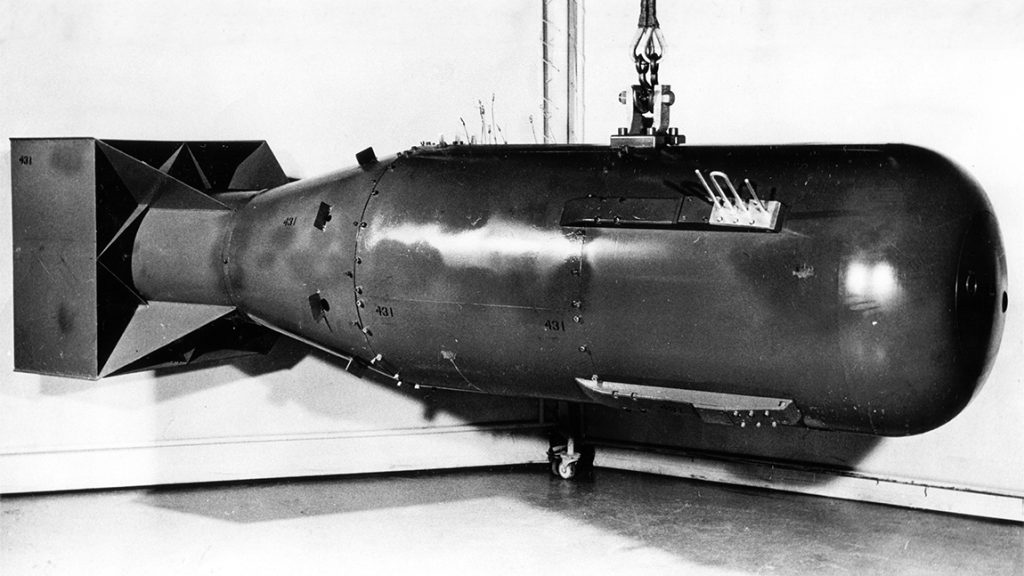
Little Boy 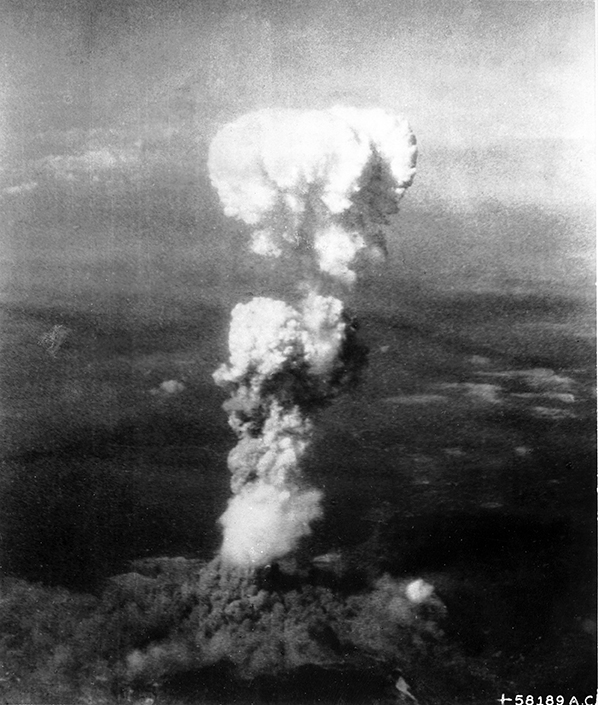
Atomic cloud over Hiroshima, Japan.
The Architect of the Atomic Bomb
Enrico Fermi was born in 1901 in Rome, Italy. His father worked for the railroad. His mom taught school. As young Enrico ploughed his way through university, he found that he had a knack for physics.
Fermi earned the Nobel Prize in 1938 at age 37. After traveling to Stockholm to receive his accolades, he and his Jewish wife Laura proceeded to America to escape the suffocating racial laws that characterized fascist Italy. Once in the U.S., Fermi eventually settled at the University of Chicago. There he busied himself piddling with uranium.
Showtime
In late 1942, Fermi and his peeps stacked some 45,000 ultra-pure graphite bricks around 50 short tons of sort-of refined uranium arranged on the squash court underneath the bleachers at the University of Chicago football stadium. They used cadmium rods to absorb excess neutrons and keep the diabolical stuff well-behaved. Fermi himself described his contraption as, “A crude pile of black bricks and wooden timbers.” They christened the device CP-1, short for Chicago Pile-1.
This was a dark road…a brave new world…an undiscovered country. Prior to this moment, the planet had never seen self-sustaining nuclear fission. In theory, raising and lowering the control rods should meter the energy output, but that was just hypothetical. This had never been attempted before.
A scientist named Samuel Allison hovered on a scaffold high above the apparatus with a big bucket of cadmium nitrate. It was hoped that, should things go truly pear-shaped, this stuff would tamp down the reaction long enough for everybody to run. However, there was no way to be sure.
Fermi and his buddies had exhaustively modeled this thing. As they calculated the sundry possible outcomes, they determined that there was a 15% probability that the reaction, once initiated, would propagate exponentially, consuming the football stadium, the city of Chicago, the state of Illinois, North America, and, eventually, the entirety of Planet Earth. Were this the case, this unprecedented reaction would have transformed our lovely big blue ball into a modest second sun—a 15% chance.
Firm in this knowledge, at 3:35 in the afternoon on December 2, they did it anyway.
CP-1 hummed to life just as advertised. The reactor ran for 4.5 minutes and produced half a watt of power. A typical household light bulb is 120 times more energetic, but the thing worked. And the Earth was not incinerated, which is obviously a plus.
Fermi and company celebrated by sharing a bottle of Chianti in paper cups. They went on to staff the Manhattan Project and build the two atomic bombs that ended World War 2. Science marches on…
The post Fuck It. We’re Doing it Live! appeared first on Field Ethos.
Continue reading...

