F
Field Ethos
Guest
By Mike Schoby
It is well known to ardent Field Ethos followers that most of us here hate tactical lever guns—in fact we are curmudgeons enough to hate anything and everything with the word “tactical” in front of it … Tactical sunglasses, Tactical lights, Tactical gloves—all so worn out and trite. We don’t mind the judicious application of modern technology. Hell, most of us have highly “tactical” guns riding in our pickups right now … from Steyr AUGs to Springfield Saints, but we are still old school enough to call them Assault rifles—not Modern Sporting Rifles.
Nomenclature and snark aside, we do appreciate modern conveniences, and it shows in our lever-action collab build with Henry; lots of cutting-edge features, but we call it practical, not tactical.
I recently got a Smith & Wesson Model 1854 chambered in .44 magnum. It’s a caliber I don’t currently have in my lever lineup but have multiple revolvers (and one semi-auto—yes, a Desert Eagle) chambered in the cartridge. I thought it would be great for close-range timber deer hunting, hog hunting and of course as camp protection in my home mountains where grizzlies are a constant threat. I have been looking at the Smith & Wessons since they were released and find them interesting for many reasons.
The 1854 is offered in multiple calibers from .357 to 45-70 and very cleanly blends modern with traditional. It is offered in walnut or synthetic pistol grip stocks. The receivers and barrels all start as stainless (which can be had as is) or coated with Armornite finish. Threaded muzzles are the norm across the line as is M-LOK attachment points on the forend on the synthetic models. Quality XS ghost ring rear sights combined with either a HIVIZ or gold bead front sits atop a short or longer pic rail (depending upon model). All models feature larger loop levers for easier operation. Interestingly enough, the tube design is one I haven’t seen before—it unlocks and twists out from the front and separates from the receiver, unlike a traditional affixed tube-within-tube design.
I feel any gun that is going to serve as bear protection should have a light attached. As my synthetic model came from the factory, mounting a Reptilia Torch light body up front on the M-LOK was easy, but due to the standard length of the forend it interfered with my hand placement. A quick search revealed that XS (famous for their ghost rings, sights and pic rails) also makes an aluminum handguard for the Smith & Wesson, as well as select Henry rifles.
I ordered one and installation took less time than it takes to write. Remove the magazine tube and factory forend, install magazine hangers inside the XS handguard with a couple of screws and slide the assembly back together, and affix a couple of set screws as a final touch. That’s it. The forend, while longer, didn’t change the weight or balance of the gun and gives many more positions to mount a light (or any other accessory for that matter). It also looks good as it extends to nearly the muzzle, and the thin design felt good in the hand—gloved or bare.
Load this rig up with the Federal HammerDown load, which pushes a 270-grain bonded soft point at 1,600+ fps. With nearly 1,600-foot pounds of energy there is not a deer, hog or even grizzly that won’t pay attention.
Cost: $1,279—Smith & Wesson 1854 Stainless; $247—XS LVR-HG Handguard.
Pros: Love the classic aesthetics combined with modern features.
Cons: Hate the cross-bolt safety. S&W, please eliminate as soon as your lawyers will let you.
The post Practical, Not Tactical appeared first on Field Ethos.
Continue reading...
It is well known to ardent Field Ethos followers that most of us here hate tactical lever guns—in fact we are curmudgeons enough to hate anything and everything with the word “tactical” in front of it … Tactical sunglasses, Tactical lights, Tactical gloves—all so worn out and trite. We don’t mind the judicious application of modern technology. Hell, most of us have highly “tactical” guns riding in our pickups right now … from Steyr AUGs to Springfield Saints, but we are still old school enough to call them Assault rifles—not Modern Sporting Rifles.
Nomenclature and snark aside, we do appreciate modern conveniences, and it shows in our lever-action collab build with Henry; lots of cutting-edge features, but we call it practical, not tactical.
I recently got a Smith & Wesson Model 1854 chambered in .44 magnum. It’s a caliber I don’t currently have in my lever lineup but have multiple revolvers (and one semi-auto—yes, a Desert Eagle) chambered in the cartridge. I thought it would be great for close-range timber deer hunting, hog hunting and of course as camp protection in my home mountains where grizzlies are a constant threat. I have been looking at the Smith & Wessons since they were released and find them interesting for many reasons.
Smith & Wesson Model 1854 Platform
The 1854 is offered in multiple calibers from .357 to 45-70 and very cleanly blends modern with traditional. It is offered in walnut or synthetic pistol grip stocks. The receivers and barrels all start as stainless (which can be had as is) or coated with Armornite finish. Threaded muzzles are the norm across the line as is M-LOK attachment points on the forend on the synthetic models. Quality XS ghost ring rear sights combined with either a HIVIZ or gold bead front sits atop a short or longer pic rail (depending upon model). All models feature larger loop levers for easier operation. Interestingly enough, the tube design is one I haven’t seen before—it unlocks and twists out from the front and separates from the receiver, unlike a traditional affixed tube-within-tube design.
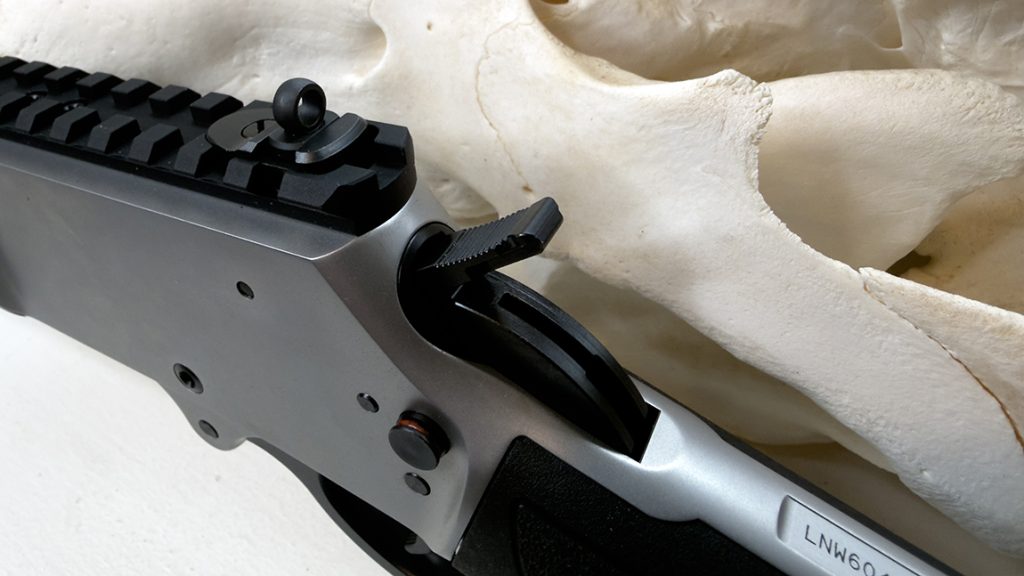
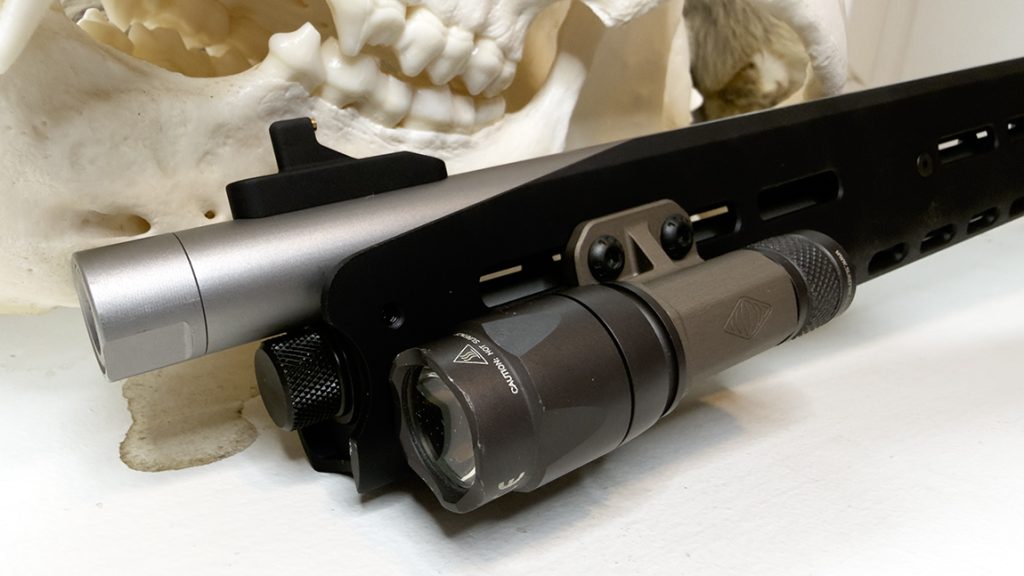
I feel any gun that is going to serve as bear protection should have a light attached. As my synthetic model came from the factory, mounting a Reptilia Torch light body up front on the M-LOK was easy, but due to the standard length of the forend it interfered with my hand placement. A quick search revealed that XS (famous for their ghost rings, sights and pic rails) also makes an aluminum handguard for the Smith & Wesson, as well as select Henry rifles.
Practical Matters
I ordered one and installation took less time than it takes to write. Remove the magazine tube and factory forend, install magazine hangers inside the XS handguard with a couple of screws and slide the assembly back together, and affix a couple of set screws as a final touch. That’s it. The forend, while longer, didn’t change the weight or balance of the gun and gives many more positions to mount a light (or any other accessory for that matter). It also looks good as it extends to nearly the muzzle, and the thin design felt good in the hand—gloved or bare.
Load this rig up with the Federal HammerDown load, which pushes a 270-grain bonded soft point at 1,600+ fps. With nearly 1,600-foot pounds of energy there is not a deer, hog or even grizzly that won’t pay attention.
Cost: $1,279—Smith & Wesson 1854 Stainless; $247—XS LVR-HG Handguard.
Pros: Love the classic aesthetics combined with modern features.
Cons: Hate the cross-bolt safety. S&W, please eliminate as soon as your lawyers will let you.
The post Practical, Not Tactical appeared first on Field Ethos.
Continue reading...


