
John Warren
Member
The Sharps rifle occupies a singular place in American firearms history, bridging the gap between muzzle-loading muskets and modern cartridge rifles while shaping warfare, hunting, and marksmanship in the 19th century.
Invented by Christian Sharps, the Sharps rifle emerged in the late 1840s as one of the most successful breech-loading designs of its era. Unlike muzzle-loaders, the Sharps used a falling-block action that allowed a shooter to load from the rear, dramatically increasing rate of fire, reliability, and safety, especially from prone or horseback.
The Sharps rifle represents a moment when craftsmanship, power, and marksmanship mattered more than volume of fire. It taught patience, discipline, and intention, qualities that still resonate with hunters, competitors, and snipers alike.
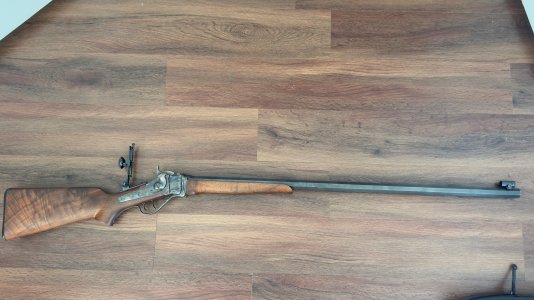
Invented by Christian Sharps, the Sharps rifle emerged in the late 1840s as one of the most successful breech-loading designs of its era. Unlike muzzle-loaders, the Sharps used a falling-block action that allowed a shooter to load from the rear, dramatically increasing rate of fire, reliability, and safety, especially from prone or horseback.
Military Origins
The rifle gained prominence through contracts with the U.S. military in the 1850s and during the American Civil War. Units such as Berdan’s Sharpshooters favored the Sharps for its accuracy and rapid reloads, using paper cartridges ignited by percussion caps. In an era dominated by massed volley fire, the Sharps enabled deliberate, aimed fire at extended ranges, giving an early hint of modern precision warfare. This rifle holds a special place in my heart as I had a family member in Berdan's Company I.The Frontier & the Buffalo Era
After the war, the Sharps evolved into a true frontier icon. With the introduction of metallic cartridges in the late 1860s and early 1870s, models like the 1874 Sharps became the rifle of choice for buffalo hunters. Chambered in powerful black-powder calibers such as .45-70, .45-90, and .45-110, the rifle delivered exceptional long-range accuracy and bone-breaking terminal performance. Entire hide camps depended on a single skilled shooter and a Sharps rifle to feed the trade.Competitive & Cultural Legacy
Sharps rifles also dominated long-range target shooting in the 1870s, winning international matches and cementing their reputation for precision. Though production declined by the late 19th century, the Sharps never disappeared. Pop culture put it in the hands of Mathew Quigley. The modern reproductions like my 1874 Shiloh have continued to be used in black-powder cartridge rifle (BPCR) competition keeping the design alive today.The Sharps rifle represents a moment when craftsmanship, power, and marksmanship mattered more than volume of fire. It taught patience, discipline, and intention, qualities that still resonate with hunters, competitors, and snipers alike.


