seantharris25
New member
Hey fellas, I wrote this article after my most recent trip to Africa. I hope you enjoy reading it as must as I enjoyed writing it.
To Be Old Where Things Die Young
This past August, I had the extreme fortune to find myself yet again on the Dark Continent. We had just entered a government game reserve in north east South Africa to hunt cape buffalo. Standing around the small administration shack was our assigned game ranger, who would be making sure our hunting activity was all above board, and a number of people from the nearby village who would be the recipients of any protein generated on this hunt. Of the villagers present, only one was introduced to me. “Madala” they called him. He was an elderly Zulu man who had obviously spent his entire life under the penetrating rays of the African sun. It was clear to me that when Madala spoke he held the attention of all present. Afrikaans and Zulu alike. Soon, we said our goodbyes and got down to the reason we were there.
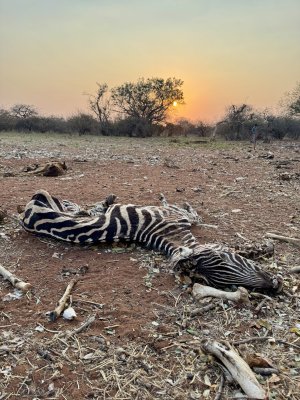
Several days and an equal number of blown stalks later, we were doing our best to change our luck on the buffalo front. Our trackers had followed the trail of a lone bull up a 1,000 foot granite escarpment that divided the reserve in half. We were just reaching the rim when a cacophony of noise, accompanied by a blur of black fur and horn, exploded out of a thicket heading away from us. We instantly ran after the bull, hoping to catch him in the open or crossing the next valley over. Within a hundred yards, it was clear that would not happen. We had bumped a small herd of zebras, adding the sound of their stampede to the now rock concert level of noise on the granite mountain. A flash of gray caught my eye and I saw a kudu bull was still feeding broadside at 50 yards. A .375 A-frame ended the day’s buffalo hunt with our consolation kudu. A truly ancient bull with chunks broken out of his horn showing its core, tattered ears, and almost no beard left. Someone called the bull “Madala” and I had thought it was just an association with the advanced age of the village elder and nothing more. We then went about the arduous process of quartering and hiking out the bull in a way that felt more like an elk hunt than something you’d expect in the bushveld.
The next day we were back on the reserve driving some of the red sand roads trying to find fresh buffalo tracks with very little success. We drove around a bend when my eagle eye PH spotted a very nice steenbok of opportunity. After folding the tiny antelope with a quickly produced .308, we walked up to recover him. His horns had good length with considerable secondary growth for being less than the width of my hand. “Very madala” our Zulu tracker said. It came to me at that moment that maybe “madala” wasn’t just a name. I asked my PH and he explained to me that “madala” was a Zulu term that effectively meant respected elder or very old one and was affectionate and deferential in use. Reflecting on what he told me, I’m not sure that we have a one singular word for that in western culture. In many ways that makes a lot of sense. Anyone who lives to a very advanced age in a country where hard living has limited the average lifespan to just over 60 years (according to google) has certainly earned the respect and admiration that being called Madala conveys.
To Be Old Where Things Die Young
This past August, I had the extreme fortune to find myself yet again on the Dark Continent. We had just entered a government game reserve in north east South Africa to hunt cape buffalo. Standing around the small administration shack was our assigned game ranger, who would be making sure our hunting activity was all above board, and a number of people from the nearby village who would be the recipients of any protein generated on this hunt. Of the villagers present, only one was introduced to me. “Madala” they called him. He was an elderly Zulu man who had obviously spent his entire life under the penetrating rays of the African sun. It was clear to me that when Madala spoke he held the attention of all present. Afrikaans and Zulu alike. Soon, we said our goodbyes and got down to the reason we were there.
Several days and an equal number of blown stalks later, we were doing our best to change our luck on the buffalo front. Our trackers had followed the trail of a lone bull up a 1,000 foot granite escarpment that divided the reserve in half. We were just reaching the rim when a cacophony of noise, accompanied by a blur of black fur and horn, exploded out of a thicket heading away from us. We instantly ran after the bull, hoping to catch him in the open or crossing the next valley over. Within a hundred yards, it was clear that would not happen. We had bumped a small herd of zebras, adding the sound of their stampede to the now rock concert level of noise on the granite mountain. A flash of gray caught my eye and I saw a kudu bull was still feeding broadside at 50 yards. A .375 A-frame ended the day’s buffalo hunt with our consolation kudu. A truly ancient bull with chunks broken out of his horn showing its core, tattered ears, and almost no beard left. Someone called the bull “Madala” and I had thought it was just an association with the advanced age of the village elder and nothing more. We then went about the arduous process of quartering and hiking out the bull in a way that felt more like an elk hunt than something you’d expect in the bushveld.
The next day we were back on the reserve driving some of the red sand roads trying to find fresh buffalo tracks with very little success. We drove around a bend when my eagle eye PH spotted a very nice steenbok of opportunity. After folding the tiny antelope with a quickly produced .308, we walked up to recover him. His horns had good length with considerable secondary growth for being less than the width of my hand. “Very madala” our Zulu tracker said. It came to me at that moment that maybe “madala” wasn’t just a name. I asked my PH and he explained to me that “madala” was a Zulu term that effectively meant respected elder or very old one and was affectionate and deferential in use. Reflecting on what he told me, I’m not sure that we have a one singular word for that in western culture. In many ways that makes a lot of sense. Anyone who lives to a very advanced age in a country where hard living has limited the average lifespan to just over 60 years (according to google) has certainly earned the respect and admiration that being called Madala conveys.