F
Field Ethos
Guest
By Charlie Benton
A dead deer makes a surprisingly comfortable pillow. I accidentally discovered the buttery soft feel and give of a deer carcass after semi-voluntarily collapsing backwards at the base of a tree on a ridge top three miles deep into the North Georgia mountains. To be clear, the deer was already on my back when I less-than-gracefully descended towards the tree trunk. I’d gutted the doe and pulled her front legs through slits in her back legs, fashioning her into a backpack to carry out.
I entered my buddy’s expanse of woods that morning with the hope of killing a bear, and my pack reflected it—heavy with the tools required to break down and haul out a bruin if I succeeded. With the afternoon waning, I’d gladly settled for a whitetail doe. Now that the time had come to lug my kill off the mountain and back to my truck, I’d added my binos, bino harness, rifle, and shooting sticks to my pack. With the doe on my back, I decided to carry my pack in my hands. These mountains are steep and covered in a layer of the world’s most slippery leaves along with a bazillion fallen trees—especially on the up-slopes.
Apparently, my core strength isn’t quite what it needs to be to stabilize 90 pounds of deadweight with a flopping neck and head on my back, and 40 pounds of pack in my hands in front of me while navigating an 80-degree incline blanketed in leaves and climbing uphill over giant swaths of downed timber. About 10 minutes into my return trek to the truck, I must have twisted wrong as I endeavored to step over a log while simultaneously hoisting my pack and bending down to avoid having my eyes raked out by rhododendron branches.
Some part of my anatomy just below my navel revolted. I couldn’t tell whether the stabbing pain was a muscle intensely contracting or my intestines tearing through connective tissue, but I could definitely tell that it hurt. I took a few more steps, crested the ridge, and then found myself lying on my back, head nestled into the doe’s chest, literally yelling “aaaaggggghhhh!” I delicately massaged my lower abdomen with my right hand while querying the internet with my left hand as to how to distinguish between a hernia and a severe cramp.
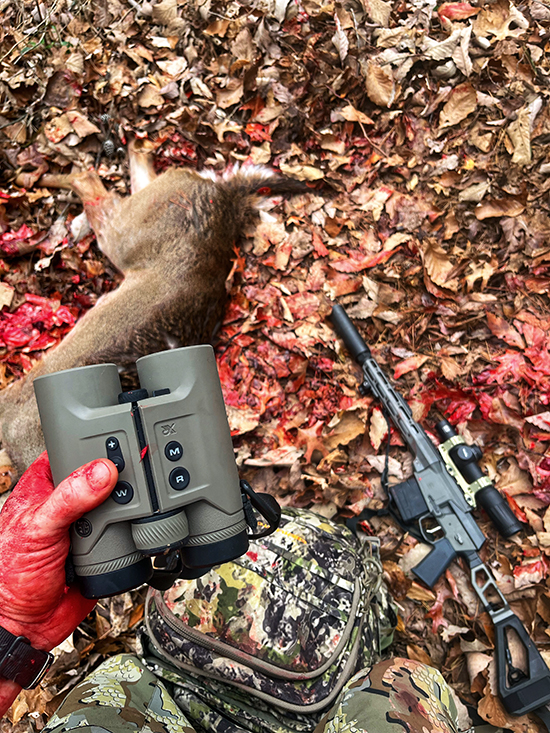
Fortunately for me and everyone who loves me, it was just a cramp, and I didn’t die of a hernia on top of the mountain. I eventually made it out of the woods at dark with the doe and all my gear. Part of that gear included my SIG Kilo10K-ABS HD Gen II binos. If I’d died on that mountain, I would blame SIG Sauer. My visual acuity is on the decline, I’m a terrible judge of windspeed, and an even more terrible judge of distance. SIG’s binos first gave me the ability to spot the very well camouflaged doe tucked into some brush at the top of a draw. The built-in rangefinder confirmed that my estimation for distance was off about 50 yards, and the Applied Ballistics System nearly simultaneously told me what to dial for elevation and wind drift.
It’s more likely than not that if the Kilos hadn’t given me that information, I wouldn’t have been able to make the shot that resulted in a dead deer, which led directly to my subsequent incapacitation. While a 50-yard discrepancy isn’t usually enough to ruin a shot, in this case, I was shooting 352-grain subs, so the drop is significant. Plus, the doe was facing me dead-on.
In addition to picking apart the North Georgia mountains, I took my Kilo10Ks to Texas a couple months back and used them to drop a stout nilgai at distance down a long stretch of two-track. That nilgai hunt involved a completely different rifle and ammo and a significantly further shot. Again, the Kilos gave me exactly the information I needed to be successful.
The SIG BDX App allows users to input ballistics data for multiple specific rifle/ammo setups and then swap and sync those profiles with the Kilo10Ks literally with the press of a button via Bluetooth. Speaking of blue, one of the improvements SIG made in the Gen II model was the elimination of the blue tint users of the Gen I model reported, even offering a side-by-side visual comparison on their site.
Other notable Gen II upgrades include metal eyecups instead of plastic and buttons for instant wind data input. There are three buttons on the top left of the unit for wind: “W,” “+,” and “-.” Once you range your target, you can immediately alter windspeed by pressing “+” or “-” and your DOPE adjusts in response—no more searching through menus and giving your target animal time to wander off. Another improved feature with the wind-related buttons is the ability to change wind direction input quickly. Look through the binos, mash the wind button, and a wind-direction-clockface appears. Toggle the “+” and “-” buttons to change wind direction, mash the wind button a second time, and your DOPE updates accordingly.
I quickly became familiar with the wind buttons and their functionality within days of my Kilos being delivered. The first rifle I input was one whose DOPE I was already familiar with. After plugging that rifle and ammo into the BDX app and syncing with my Kilos, I noticed the binos were giving me a much different holdover than what I knew to be true. I called a customer service contact at SIG and led off with the fact that, based on what I know about myself, I was pretty sure my issue was user error and not a problem with their product. Turns out, I was right. True to form, I didn’t read any directions before mashing a bunch of buttons. In my uneducated exploration, I managed to lock in a significantly incorrect windspeed and direction—both of which were easily remedied, and the DOPE was spot on.
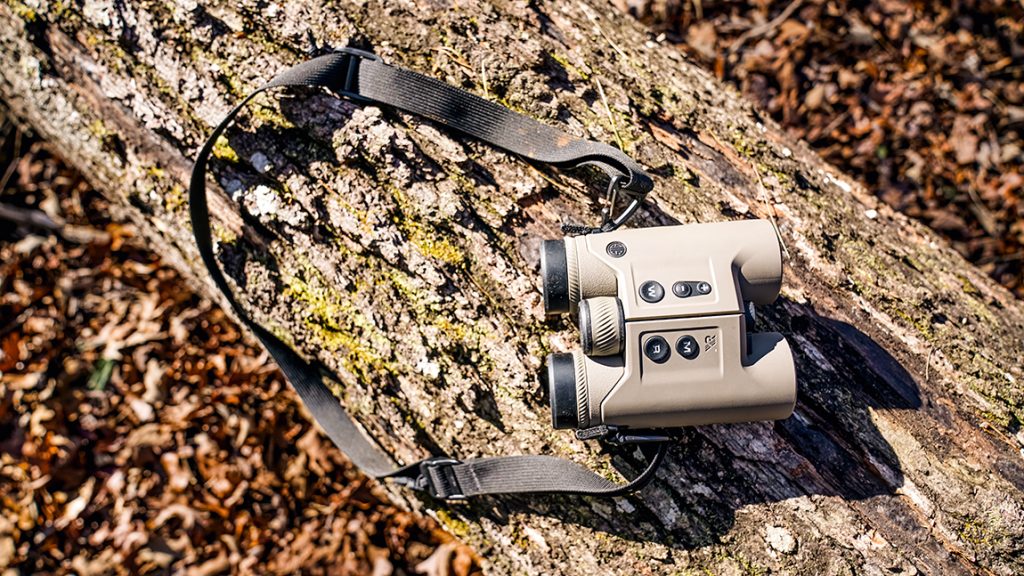
My only complaint has nothing to do with the binos themselves. Instead, my gripe is about the neck strap that comes with the unit. The strap itself is plain nylon with no neoprene and no padding. The clips provided are plastic with a thin metal tension arm and don’t inspire confidence in their longevity. The Kilo10Ks are premium binoculars and should come with a padded strap for comfort and a substantial attachment mechanism that will withstand years of hard use.
Singular complaint aside, I’ve used these binos in the heat of the Texas sun and in sub-freezing temperatures in the mountains. In both settings and everything in between the glass remained clear, and as long as I input the correct data about my rifle and ammo, the unit functioned perfectly. Several animals have died noble deaths over the last few months thanks to my Kilo10Ks. In an industry where companies routinely produce new generation models with relatively pointless modifications in a desperate attempt to draw attention, it’s pretty great to see SIG Sauer make such substantive improvements in a second-generation product.
Cost: $2,699.99
Pros: Extremely user-friendly, easy to make real-time wind adjustments, range and DOPE read-outs are fast and accurate, clear glass, hardy construction
Cons: Quality of the neck straps and clips is incongruent with the premium quality of these binos
The post Writhing on a Mountaintop: SIG Sauer Kilo10K Gen II appeared first on Field Ethos.
Continue reading...
A dead deer makes a surprisingly comfortable pillow. I accidentally discovered the buttery soft feel and give of a deer carcass after semi-voluntarily collapsing backwards at the base of a tree on a ridge top three miles deep into the North Georgia mountains. To be clear, the deer was already on my back when I less-than-gracefully descended towards the tree trunk. I’d gutted the doe and pulled her front legs through slits in her back legs, fashioning her into a backpack to carry out.
I entered my buddy’s expanse of woods that morning with the hope of killing a bear, and my pack reflected it—heavy with the tools required to break down and haul out a bruin if I succeeded. With the afternoon waning, I’d gladly settled for a whitetail doe. Now that the time had come to lug my kill off the mountain and back to my truck, I’d added my binos, bino harness, rifle, and shooting sticks to my pack. With the doe on my back, I decided to carry my pack in my hands. These mountains are steep and covered in a layer of the world’s most slippery leaves along with a bazillion fallen trees—especially on the up-slopes.
Apparently, my core strength isn’t quite what it needs to be to stabilize 90 pounds of deadweight with a flopping neck and head on my back, and 40 pounds of pack in my hands in front of me while navigating an 80-degree incline blanketed in leaves and climbing uphill over giant swaths of downed timber. About 10 minutes into my return trek to the truck, I must have twisted wrong as I endeavored to step over a log while simultaneously hoisting my pack and bending down to avoid having my eyes raked out by rhododendron branches.
Some part of my anatomy just below my navel revolted. I couldn’t tell whether the stabbing pain was a muscle intensely contracting or my intestines tearing through connective tissue, but I could definitely tell that it hurt. I took a few more steps, crested the ridge, and then found myself lying on my back, head nestled into the doe’s chest, literally yelling “aaaaggggghhhh!” I delicately massaged my lower abdomen with my right hand while querying the internet with my left hand as to how to distinguish between a hernia and a severe cramp.
Surviving the Mountain
Fortunately for me and everyone who loves me, it was just a cramp, and I didn’t die of a hernia on top of the mountain. I eventually made it out of the woods at dark with the doe and all my gear. Part of that gear included my SIG Kilo10K-ABS HD Gen II binos. If I’d died on that mountain, I would blame SIG Sauer. My visual acuity is on the decline, I’m a terrible judge of windspeed, and an even more terrible judge of distance. SIG’s binos first gave me the ability to spot the very well camouflaged doe tucked into some brush at the top of a draw. The built-in rangefinder confirmed that my estimation for distance was off about 50 yards, and the Applied Ballistics System nearly simultaneously told me what to dial for elevation and wind drift.
It’s more likely than not that if the Kilos hadn’t given me that information, I wouldn’t have been able to make the shot that resulted in a dead deer, which led directly to my subsequent incapacitation. While a 50-yard discrepancy isn’t usually enough to ruin a shot, in this case, I was shooting 352-grain subs, so the drop is significant. Plus, the doe was facing me dead-on.
In addition to picking apart the North Georgia mountains, I took my Kilo10Ks to Texas a couple months back and used them to drop a stout nilgai at distance down a long stretch of two-track. That nilgai hunt involved a completely different rifle and ammo and a significantly further shot. Again, the Kilos gave me exactly the information I needed to be successful.
SIG Kilo10K-ABS HD Gen II Details
The SIG BDX App allows users to input ballistics data for multiple specific rifle/ammo setups and then swap and sync those profiles with the Kilo10Ks literally with the press of a button via Bluetooth. Speaking of blue, one of the improvements SIG made in the Gen II model was the elimination of the blue tint users of the Gen I model reported, even offering a side-by-side visual comparison on their site.
Other notable Gen II upgrades include metal eyecups instead of plastic and buttons for instant wind data input. There are three buttons on the top left of the unit for wind: “W,” “+,” and “-.” Once you range your target, you can immediately alter windspeed by pressing “+” or “-” and your DOPE adjusts in response—no more searching through menus and giving your target animal time to wander off. Another improved feature with the wind-related buttons is the ability to change wind direction input quickly. Look through the binos, mash the wind button, and a wind-direction-clockface appears. Toggle the “+” and “-” buttons to change wind direction, mash the wind button a second time, and your DOPE updates accordingly.
I quickly became familiar with the wind buttons and their functionality within days of my Kilos being delivered. The first rifle I input was one whose DOPE I was already familiar with. After plugging that rifle and ammo into the BDX app and syncing with my Kilos, I noticed the binos were giving me a much different holdover than what I knew to be true. I called a customer service contact at SIG and led off with the fact that, based on what I know about myself, I was pretty sure my issue was user error and not a problem with their product. Turns out, I was right. True to form, I didn’t read any directions before mashing a bunch of buttons. In my uneducated exploration, I managed to lock in a significantly incorrect windspeed and direction—both of which were easily remedied, and the DOPE was spot on.
My only complaint has nothing to do with the binos themselves. Instead, my gripe is about the neck strap that comes with the unit. The strap itself is plain nylon with no neoprene and no padding. The clips provided are plastic with a thin metal tension arm and don’t inspire confidence in their longevity. The Kilo10Ks are premium binoculars and should come with a padded strap for comfort and a substantial attachment mechanism that will withstand years of hard use.
Legit Field Performance
Singular complaint aside, I’ve used these binos in the heat of the Texas sun and in sub-freezing temperatures in the mountains. In both settings and everything in between the glass remained clear, and as long as I input the correct data about my rifle and ammo, the unit functioned perfectly. Several animals have died noble deaths over the last few months thanks to my Kilo10Ks. In an industry where companies routinely produce new generation models with relatively pointless modifications in a desperate attempt to draw attention, it’s pretty great to see SIG Sauer make such substantive improvements in a second-generation product.
Cost: $2,699.99
Pros: Extremely user-friendly, easy to make real-time wind adjustments, range and DOPE read-outs are fast and accurate, clear glass, hardy construction
Cons: Quality of the neck straps and clips is incongruent with the premium quality of these binos
The post Writhing on a Mountaintop: SIG Sauer Kilo10K Gen II appeared first on Field Ethos.
Continue reading...