What’s Your Gun Cleaning Routine?

  • Join our community of outdoor enthusiasts! Subscribe to Field Ethos Magazine to unlock full forum access and connect with fellow adventurers sharing their stories, tips, and experiences.

    If you are already a subscriber, log in here.
@Steven Donovan

That’s the best technical write-up I’ve seen on the topic since my instructor’s at long range school. THANK YOU. That was my point in starting this thread, to get perspective and difference shared among members. Super helpful.

There is a lot more to this than people realize. An understanding of what actually affects "shooting ability" is also important. Additionally, the actual solvents/cleaners you use matter. Cleaning the barrel, cleaning the mechanisms of the gun, and maintaining the outer surface are all separate cleaning - maintenance - lanes. Frequency of cleaning also depends on conditions. Also depends on the firearm.

I do a general clean after every shoot/range day.

Barrel-
Bolt action:
A couple barrel cleans with a soft plastic/bendable non-metal rod with cleaning patches (patches only) - with all metal parts of the rod being only copper, so as to be softer than the barrel itself. In the initial push-through I put a few drops of Hoppes classic number 9 cleaner (not oil) on the patch. Hoppes 9 (the classic) cleaner because it removes excessive carbon/gunk but leaves the copper that inherently fills the imperfections in the barrel. After the initial swab through with the patch with Hoppes 9 cleaner, every follow-on swab is with a patch with no cleaner. Once the carbon has been wiped out, I run the last swab with a drop or two of the Hoppes classic number 9 oil (not the cleaner) to apply a very light preservative layer.

People often confuse or don't understand the difference between carbon and copper build up. Some cleaners clean carbon, and some clean carbon and copper. Copper is "placed" by the bullets themselves as they travel down the barrel. Carbon residue is the result of the propellant being burnt during firing. In regard to copper - as good as any barrel is, there will be microscopic imperfections. A manageable amount of copper build-up inherently fills those imperfections and "smoothens" the barrel (making it potentially more consistent). However, an excessive amount of copper build-up can negatively affect barrel performance as well. In bolt action rifles, it can take a very long time for copper to build up excessively, so a "copper clean" is usually only needed after a significant amount of bullets have been fired. In regard to carbon - carbon does not inherently affect barrel performance in a positive way - it is only a negative when it becomes excessive, and keeping a barrel clear of it just keeps the barrel in "good order" and allows you to have the highest level of consistency. For bolt action rifle barrels, keeping carbon build-up minimized and allowing a slight level of copper to fill-in imperfections (while not allowing it to become excessive) is usually going to be the best strategy to achieve the highest level of barrel consistency.

****Barrel temperature and ballistic performance based off temperature is a separate factor/variable in accuracy/precision.

Semi-auto/combat:
For close combat firearms like assault rifles, battle rifles, and semi-auto handguns, the copper build-up can be much much higher in a shorter amount of time as compared to bolt-action rifles - due to round count (with carbon build up being proportional as well). This is why cleaners such as the Hoppes "elite" were created - they were designed to clear the excess copper and carbon build up caused by high round count "rapid firing". As a general rule, it's best to keep close combat barrels consistently clean of both excess carbon and copper.

Mechanisms-
Bolt action:
This isn't very hard. A light wipe with some very light cloth or patches to remove carbon (what little there may be) is generally all that is needed. Very light layer of oil after.

Semi-auto/combat:
This can very much depend on firearm, but a good disassembly with cleaning to remove carbon/dirt/dust debris is ideal - when conditions realistically allow. At this point, you are maintaining the mechanisms of a machine and not just a "firearm." A light even medium layer of lubricant goes a long way after cleaning (though as a note, appropriate lubricant levels can vary highly based on region/weather/conditions). For battle/combat/intense training situations, a couple drops/spray of lubricant can keep "the machine" going. The goal is to keep the mechanisms as reliable as possible, as consistently as possible. You don't want the mechanisms to fail when you need them most.

Exterior-
Bolt action:
I use a light layer of Hoppes 9 oil on all the metal as a natural protectant. Less is more. I also put a layer of Parker & Bailey Lemon Oil Polish on the wood. Lemon oil is a very good renewer for wood (usage takes into account any finish you have had on the wood).

Semi-auto/combat:
A light layer of oil to keep the metal preserved.

-------------------------------------
It's important to remember that cleaning/maintenance does have a purpose - and everything you do should be linked to a practical effect/outcome.

Tragically, there can be extremes in this conversation. We have seen some military members that themselves don't know that much about firearms (highly unit/era dependent) strip away the rifling in a barrel by using a rod/brush with the incorrect metal. Often just because they were "told to do so." Conversely, you will see police officers that will never maintain their firearm - and then when it is needed most it jams/locks up.

If someone cleans/maintains with the practical purpose of maximizing reliability, consistency, accuracy, and precision, I think they are generally on the right path. I would advise caution doing anything without actually knowing the "why."

Also, I think a lot of this, like anything else, develops through education and learning.
 
I was Marine who was trained to clean his weapons every time they were shot, so cut me some slack. I have changed that as I have aged and gained knowledge.

My 7 PRC gets cleaned every 100 rounds because it has a propensity for carbon fouling. My other bolt actions get cleaned once a year, usually after hunting season and I always put 5-10 rounds downrange before the season starts.

Pistols get the barrel and slide wiped down every couple hundred rounds. And a good deep cleaning once per year(ish).

Shotgun, depends on what I'm hunting. For ducks I clean it after every hunt because they always get gunked up in the mud and water. For dove, turkey, and quail, I just clean it when the season is over using a bore snake.

I'm like some others here and will occasionally just get some guns out and clean them. I find cleaning weapons to be a very meditative and calming exercise. I put on some good music and get to cleaning. I only do that when the wife is not home because I don't want to be interrupted.
 
I need to work on my storage more so than the cleaning. Pretty good at wiping them down and then putting a little oil on them.

My guns are stored in a concrete room in the basement. We build a saferoom into the house. It gets really cold and clammy down there. My guns tend to rust a little.
Healthy room temperature is best! Cold/clammy not good!
 
Personally, I don't have a specific "gun" cleaning regimen for my pistols or sub guns.. full auto MP5s suck and are a pain in the butt to clean, especially suppressed using subsonic ammo as are the HK 53s and such.. ultimately they eventually need to be cleaned or the action starts slowing or failing to properly cycle. On our sub guns and pistols we averaged 13,000 rounds annually for each. I used my M-4 for ten years at that rate before exchanging it for a new rifle and it never failed me. Same with my Glocks.

For our sniper rifles I became more regimented.. especially with new in box guns but only during the "barrel break in" phase. We can debate forever about it, but after years of experience I really believe in proper break in (more than a specific cleaning method after break in)..

The barrel break in method we used and preferred was fire one round... Clean the barrel, fire another, clean the barrel... Continue this for a box and a half of rounds.. after that we never regularly cleaned our rifles and we never EVER showed up on a callout with a freshly cleaned barrel. Our cold bore shots proved that a freshly cleaned barrel changed our POI on a cold bore shot versus our POA. If we got our rifles dialed in during a training day we left our guns dirty (at least the bore/barrel) in the event we got a callout during the night.

In the LE Sniper world mistakes are unforgivable.
 
@Steven Donovan

That’s the best technical write-up I’ve seen on the topic since my instructor’s at long range school. THANK YOU. That was my point in starting this thread, to get perspective and difference shared among members. Super helpful.
I am always open to learning more and being corrected if I am wrong. I also do not claim to know everything by any stretch, but I feel fortunate to have been at the intersection of many experiences related to ballistics and guns in general.

All of this is something that we actually heavily studied in the US Army's field artillery gunnery school – and is something that is still studied today. Believe it or not, we actually do have hard data relating to this subject. The ballistics of artillery guns is the "same science" as the ballistics of small arms. Also, at a practical level, I have seen the principles carry over.

In the artillery, we specifically called it coppering. After only a few rounds (4-6), especially at a higher charge, the barrel would be coated with a thin layer of copper. The primary effect was an increase in overall muzzle velocity and a decrease in muzzle velocity variation. In other words, the shells traveled faster and there was far less variation in velocity between each shell (which would increase accuracy/precision). It basically made the gun barrel "better." However, there would be a point in the barrel's lifespan where the amount of copper would become excessive. When a barrel would get too much coppering (and we would start to see a sharp decrease in accuracy/precision), we would have ordnance teams perform a special cleaning procedure to remove the excess copper. This coppering cleaning was done infrequently. The cleaning would change the ballistic parameters of that specific gun tube, and we would have to ensure we did a re-calibration (a fancy way of saying we would shoot the gun again to get a new set of baseline ballistic data for said gun - and do a "re-coppering").

In terms of carbon/propellant levels, we found very consistently that the variation in muzzle velocity between rounds fired out of "carbon dirty" tubes and clean tubes was actually about the same. In the 105mm gun, the shells fired out of both tubes (carbon dirty and carbon clean) would often have a variation within 3-4 meters a second between each shell fired out of each respective gun tube. In other words, they were actually generally consistent from shot to shot. However, the overall average velocity change between the shells fired from each tube (clean vs carbon dirty) was noticeable. Barrels with excess carbon/propellant residue would have an average muzzle velocity that was usually around 12-13 meters a second slower than the clean tube. In other words, a clean barrel would consistently shoot at + 4 meters a second whereas a dirty barrel would consistently shoot at - 7 meters a second. One was consistently faster, and one was consistently slower. The slower shell would be more susceptible to wind, air resistance, gravity, etc, and therefore make it less accurate/precise over range. Also, excess carbon residue would generally make the travel of the shell down the barrel "rougher," and increase the amount of pitting in the tube.

It's also worth noting - and this is important - that all gun barrels are unique in their own way, and they sometimes do have to be cared for/cleaned differently. As good as our metallurgy is, it isn't perfect. It wasn't uncommon to have variations in different tubes of about 4 meters a second "from the factory"- but we would calibrate/collect data to compensate for that. Small rifle barrels are actually no different... and each may be more susceptible to differing levels of wear or usage, especially considering different levels of propellant used.
 
Personally, I don't have a specific "gun" cleaning regimen for my pistols or sub guns.. full auto MP5s suck and are a pain in the butt to clean, especially suppressed using subsonic ammo as are the HK 53s and such.. ultimately they eventually need to be cleaned or the action starts slowing or failing to properly cycle. On our sub guns and pistols we averaged 13,000 rounds annually for each. I used my M-4 for ten years at that rate before exchanging it for a new rifle and it never failed me. Same with my Glocks.

For our sniper rifles I became more regimented.. especially with new in box guns but only during the "barrel break in" phase. We can debate forever about it, but after years of experience I really believe in proper break in (more than a specific cleaning method after break in)..

The barrel break in method we used and preferred was fire one round... Clean the barrel, fire another, clean the barrel... Continue this for a box and a half of rounds.. after that we never regularly cleaned our rifles and we never EVER showed up on a callout with a freshly cleaned barrel. Our cold bore shots proved that a freshly cleaned barrel changed our POI on a cold bore shot versus our POA. If we got our rifles dialed in during a training day we left our guns dirty (at least the bore/barrel) in the event we got a callout during the night.

In the LE Sniper world mistakes are unforgivable.
You're not wrong in terms of change in POI vs POA. Even if differing people have different "variations" of what "barrel break-in" may or may not be... the changing of the material in the barrel, whether carbon or copper, "clean or unclean," can/does change the travel of the bullet through the barrel... and therefore can/does change point of impact. It's definitely a good policy, in this LE case, to not change the "nature of the barrel" between last training/zeroing and actual real-world LE use.
 
Most of my guns simply get wiped-down after I use them. Plastic guns don’t deserve that.

If I’m cleaning a rifle after putting a lot of rounds down the bore, I basically follow this technique (Speedy is a big deal in the benchrest/F-Class world and knows his stuff):


Thanks for the video link. Im not familiar with him.
 
One other thing that I might add, specifically with regards to our sniper rifles (we aren't as anal about our sub guns or pistols) was the use of a bore guide when cleaning the barrel. It may have already been covered on this thread and I missed it, and if so I apologize. But on our precision rifles, we insist on using a bore guide.. it probably is a moot point if you're only shooting a few rounds a year during deer season, but when you are shooting a thousand rounds monthly and pushing a cleaning rod down your barrel, we found that the process of cleaning itself can induce throat wear at the bore if you are not careful, simply by the rod or brush wobbling and rubbing along the edges of the bore... Throat wear can impact accuracy.. likewise at the muzzle end. Which is why on our precision rifles (when we cleaned them) we only pushed the brush through the direction the bullet travels and did not pull it back through in reverse, reason being is that it can eventually lead to wear at the muzzle end where the bullet exits the barrel which also can impact accuracy... Not a big deal when an inch and a half group at a hundred yards is acceptable to someone, but if you are trying to consistently, repeatedly stack bullets or conducting a simultaneous sniper shot with your partner through a heavy sliding glass door and you want one bullet penetrating the barricade and the second bullet following it through the same entry hole then you need consistent accuracy..

Also, regarding copper brushes... we didn't use copper brushes... Reason being if you are using copper cleaning solvents and trying to remove copper buildup, why the hell would you introduce copper into the barrel by using a copper bore brush?

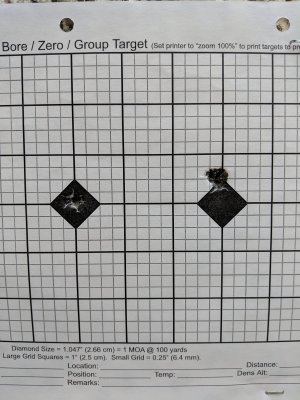
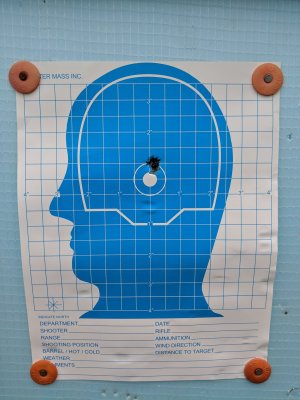
In the photos below, it's hard to tell but there's multiple shots through those bullet holes, except in the white target (black diamond on the left) that's a cold bore shot. The blue target is four rounds, my partner and I practicing our simultaneous "barricade penetrating" shot. We conducted two repetitions.. each trying to simultaneously fire one round at the same point on the target.. the distance is only 100 yards on all these target examples, but it's demonstrative of what I'm trying to say and why we are so anal about our cleaning regimen (and lack thereof) on our precision rifles. They are precise instruments and need to be cared for as such.
 

Attachments

  • IMG_20190513_115551.jpg
    IMG_20190513_115551.jpg
    2.1 MB · Views: 4
  • IMG_20190430_094613.jpg
    IMG_20190430_094613.jpg
    1.5 MB · Views: 4
Back
Top